How ISAE Works
Enrollment where people are, not arrest
Screens below are from a clickable prototype with made-up sample data. They show the intended design; no real system exists.
Try the app
The clickable ISAE prototype (made-up sample data) is available on this site. Access is by invitation and requires a password.
1. We come to you: field enrollment
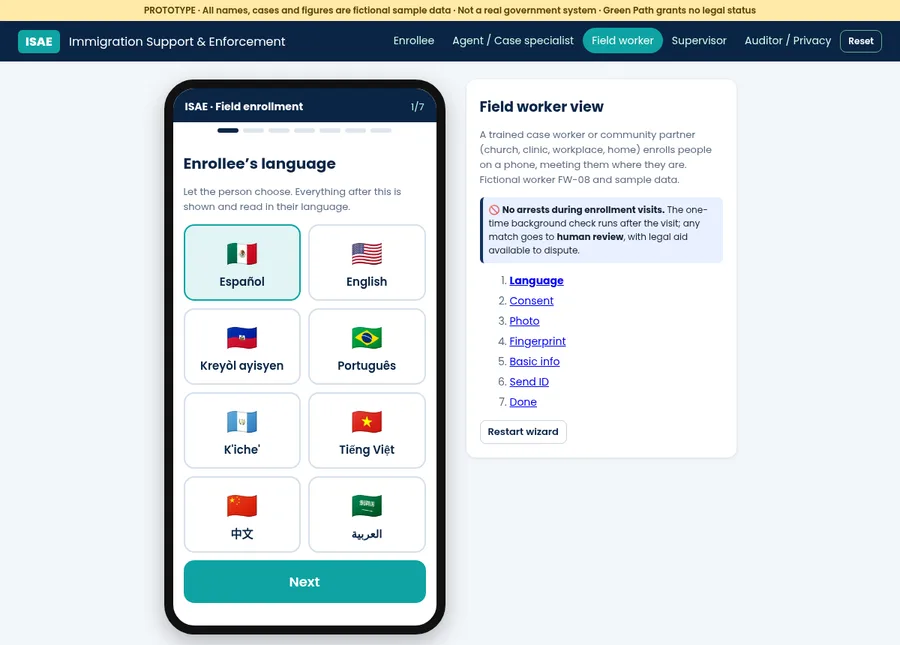
Enrollment happens where the person is, not at a government building. Trained ISAE case workers or contracted community partners (legal-service providers, faith and community organizations) do it at the person’s home, workplace, or a community location of their choosing.
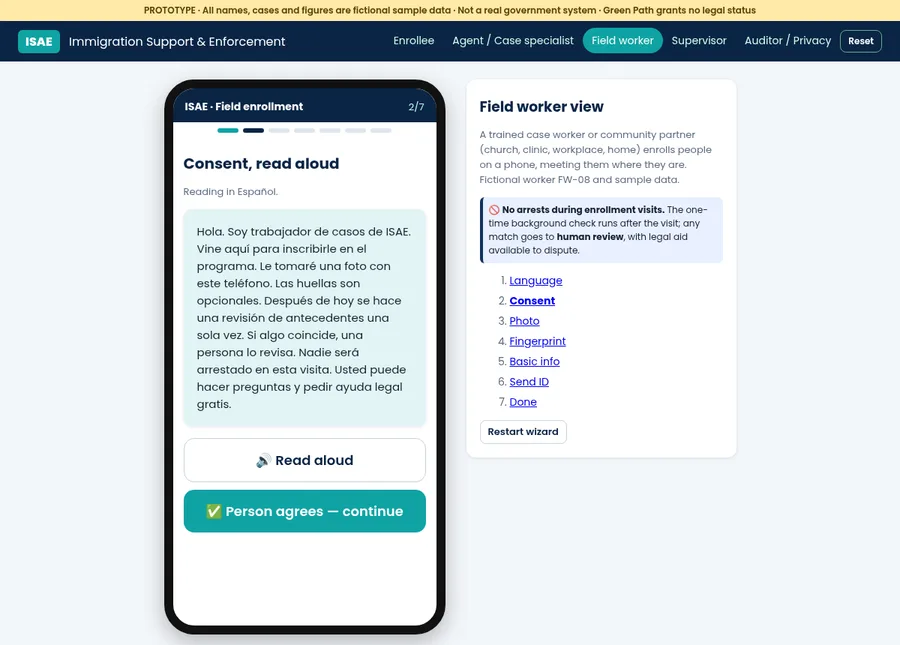
- The person picks their language and hears the consent notice read aloud: what is collected, why, who can see it, and how long it is kept.
- A photo is taken on the case worker’s phone, with a framing guide and quality check.
- A fingerprint step is optional; a phone with only a camera can complete the enrollment.
- No arrests take place at enrollment.
2. A temporary ID by text message
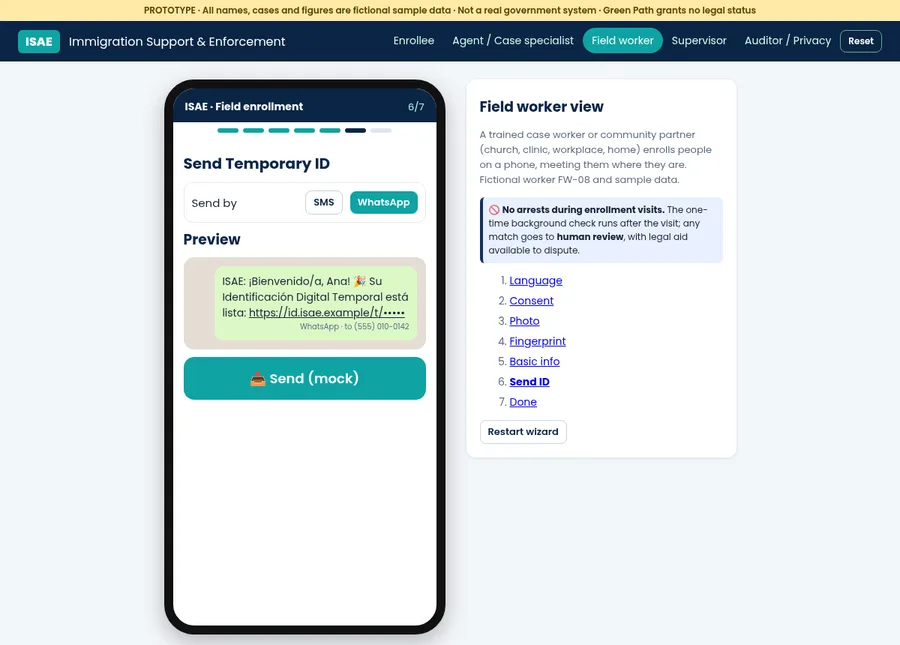
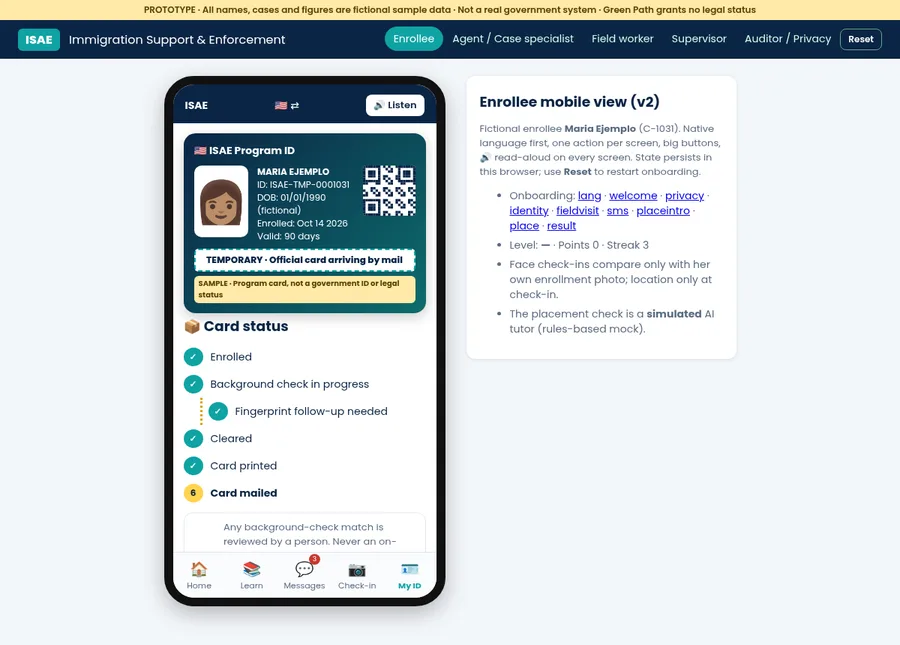
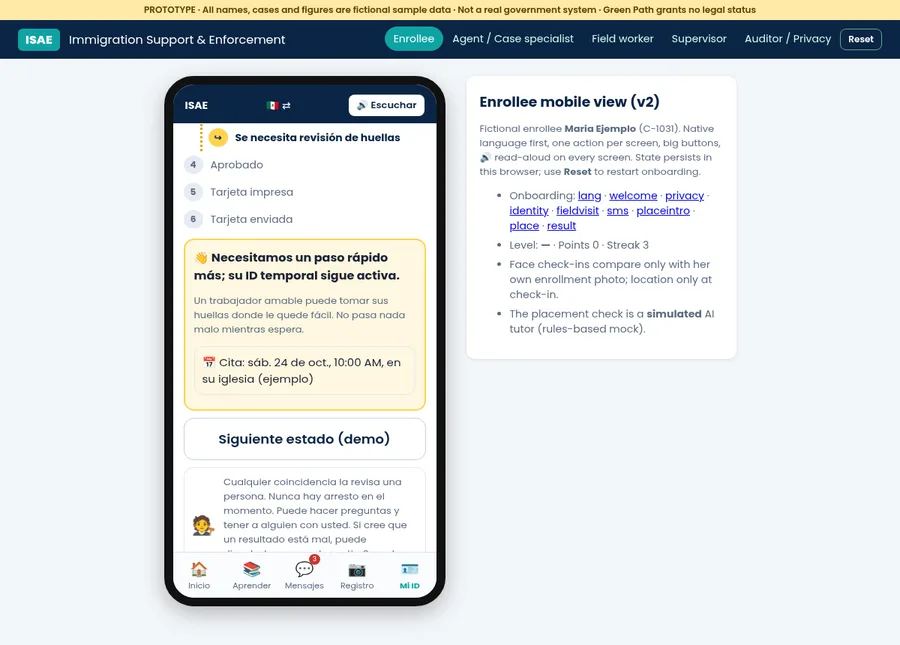
At enrollment the participant receives a temporary digital ID and their obligations by SMS or WhatsApp, in their language. They do not need to install an app or own a smartphone to begin. A tracker shows each step until the printed card arrives. In law, the credential (a Provisional Integration ID) rests on existing authorities: case-by-case deferred action or parole, an Employment Authorization Document, and an SSN or ITIN for taxes.[23] It is not a new immigration status.
3. Identity checks, and the fingerprint follow-up rule
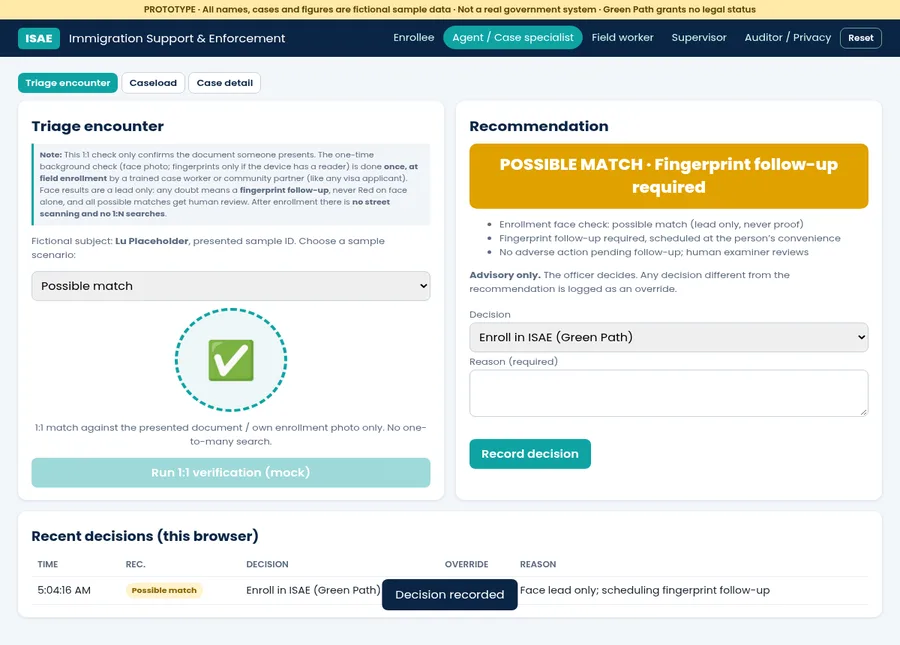
- One-time 1:N face check at enrollment only, against criminal-history databases. Any result is an investigative lead only, never an identification, mirroring the FBI’s own rule that its face search is “only used as an investigative lead, and not as a means of positive identification.”[24]
- If there is any doubt, fingerprints follow at a later scheduled time. Fingerprints are the established standard for positive identification.
- No adverse action in the meantime. The person stays enrolled with full protections and the temporary ID stays active. Any later enforcement step requires a confirmed identification and separate review.
- Check-ins are 1:1 only: is this the enrolled person, compared against their own photo. Never a database search.
4. The Green Path
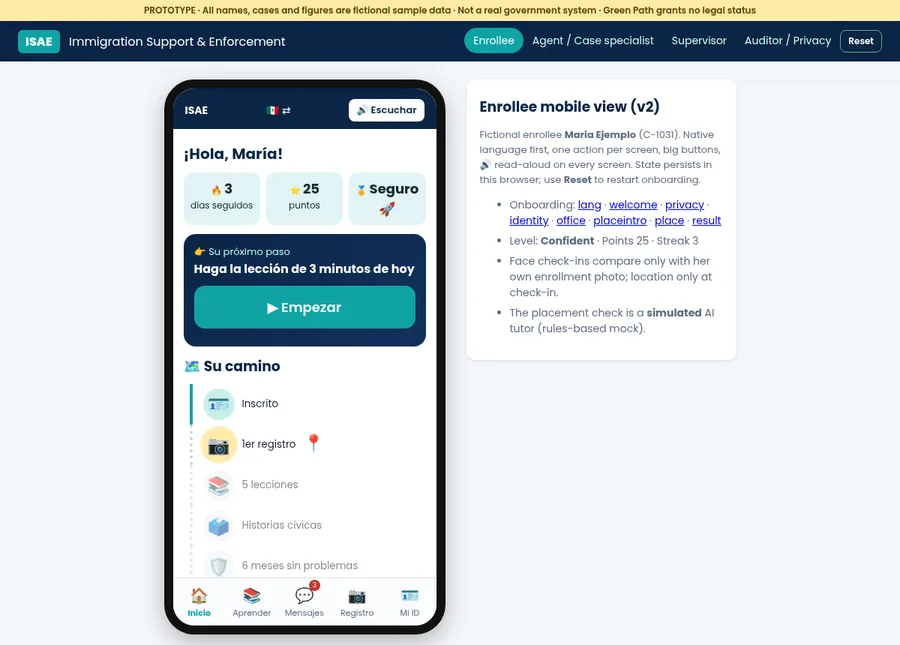
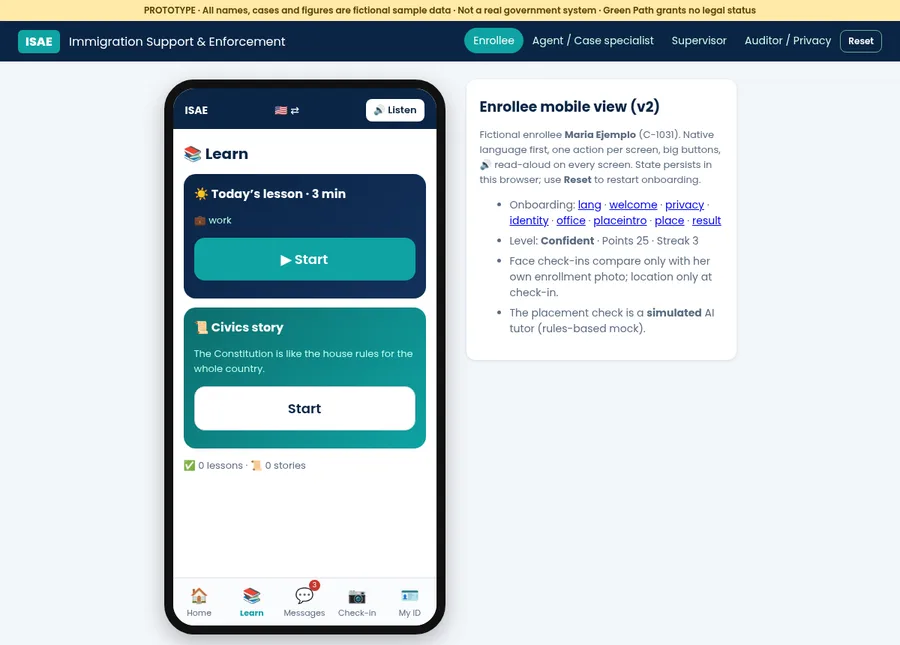
A five-year, step-by-step track. Five years matches the residence period before a permanent resident may apply to naturalize, and the English and civics milestones mirror the naturalization test.[25] [26] The Green Path itself does not confer permanent residence or citizenship; only Congress can do that.
| Track | Example milestones | Verification |
|---|---|---|
| Accountability | Attend every hearing and check-in; keep a current address | Court tracking, check-in log |
| Clean record | No disqualifying arrests or convictions; periodic re-checks | FBI/DHS checks |
| Self-sufficiency | Lawful employment once authorized; annual tax filing | EAD, tax transcript |
| English | Progressive levels via short in-app and partner lessons | Assessed modules |
| Civics | Units modeled on USCIS civics content | Assessed modules |
| Community | Optional volunteering; school enrollment for children | Partner attestations |
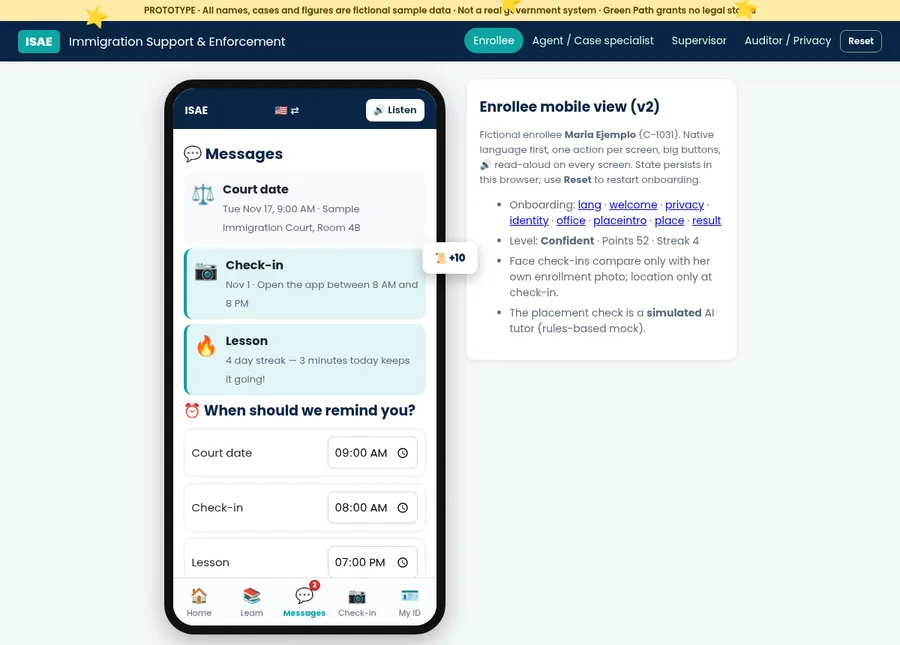
Milestones unlock lawful benefits within agency discretion: fewer check-ins, a lower supervision tier, longer renewal periods, and priority for any status Congress later creates. Missed obligations trigger a stepped response (an outreach call, then more supervision, and only then enforcement referral), never automatic arrest. Lessons are short, in the person’s own language, and adapt to their level so people succeed early.
5. Translate / Traducir
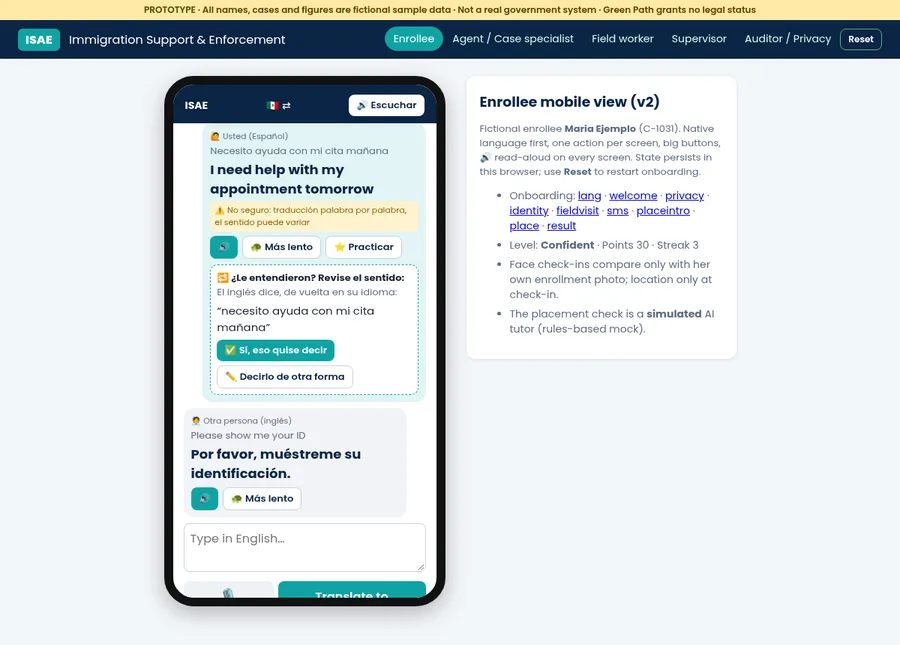
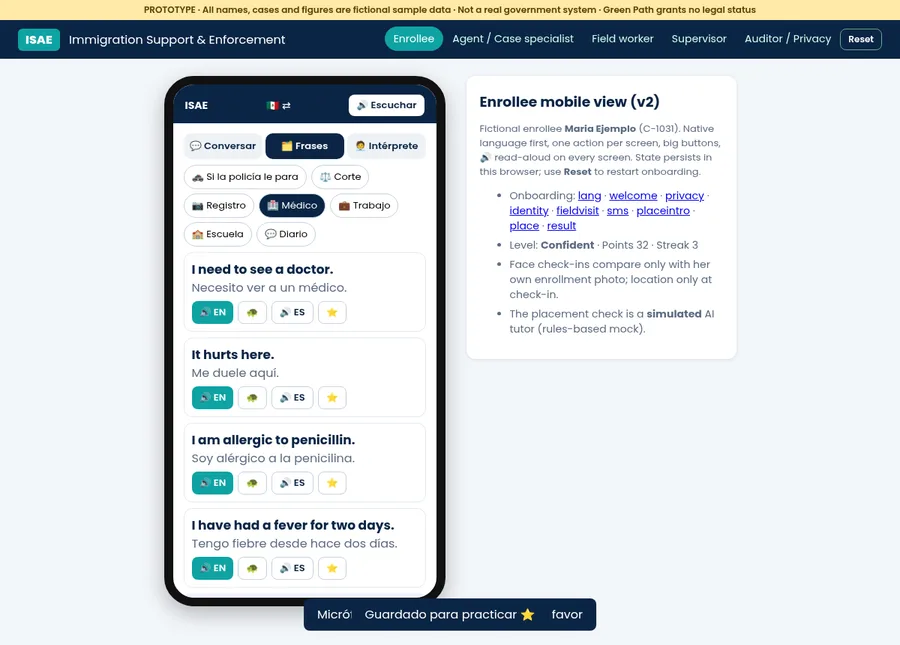
A two-way translation helper on every screen: the enrollee writes in their language, the other person reads English, and back. Each message can be read aloud. After each message a back-translation lets the person confirm it says what they meant, and low-confidence phrases are flagged.
The helper supports communication but never replaces a certified interpreter for court, legal papers, police or medical consent. One tap requests a human interpreter. A real version would use a vetted service with no vendor retention or model training on participant data. Speech input is planned.
6. De-escalation triage: a person always decides
- Green: no criminal convictions or disqualifying charges, not subject to mandatory detention, verified identity. Recommended: administrative enrollment. No custodial arrest.
- Yellow: minor history or incomplete information. Recommended: supervisor review and a higher supervision tier. Missing data defaults to yellow, never green or red.
- Red: public-safety or national-security concern, mandatory-detention category, or an executable final order. Recommended: standard enforcement.
The law sets the floor: mandatory-detention statutes, including the 2025 Laken Riley Act, still apply.[27] The dashboard recommends; the officer decides and records reasons for any departure, audited in both directions. Any score must be published, tested for disparate impact, and open to challenge.
7. The privacy firewall
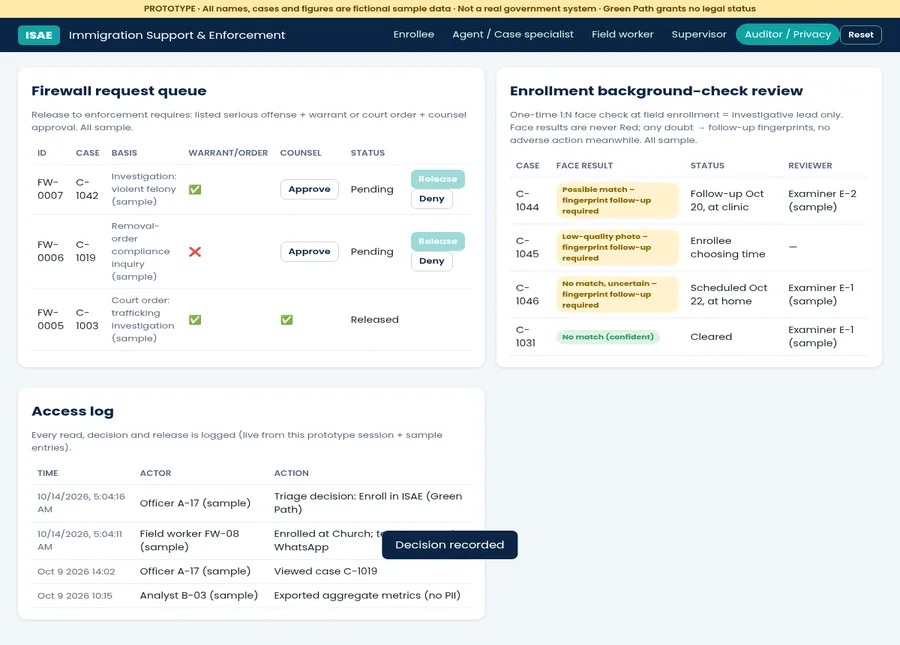
Enrollment data may be used only for supervision, services and the participant’s own case. It may never be used to target participants, their families, or their communities. Exceptions are limited to a short list of serious criminal grounds, each requiring a judicial warrant or court order. Location is captured only at check-in; there is no continuous tracking. Full privacy and civil-liberties design →