Languages
If people cannot understand it, it cannot be fair
A program that sends court dates and rights notices people cannot read will fail, and its compliance numbers will mean little. Language access is part of the core design, not a later add-on.
The scope of the need
- Where people come from. Mexico accounted for 40% of the unauthorized population (about 5.53 million) and Guatemala for 10% (about 1.40 million), followed by Honduras and El Salvador at 8% each. The Philippines (about 294,000) and Brazil (about 286,000) were each about 2%.[69]
- What they speak at home. In MPI’s state-level analysis, the top home languages of unauthorized immigrants nationally were Spanish, English, Chinese, Tagalog and Korean. Haitian Creole and Portuguese ranked in Florida’s top five, and Vietnamese in Texas’s.[71] Those data are from 2012–16, before recent arrivals from Venezuela, Colombia and elsewhere.
The hidden layer: Indigenous languages
Surveys often record “Spanish” for people whose first language is Mixteco, Zapoteco, Triqui, K’iche’ or Mam. So the people with the greatest language barrier are largely missing from the standard statistics.
- The Indigenous Farmworker Study estimated about 120,000 Indigenous Mexican farmworkers in rural California, about 165,000 with children. Over half spoke Mixteco, 26% Zapoteco and 9% Triqui. The authors say the real total is “considerably higher,” because the count left out cities and non-Mexican Indigenous immigrants such as Guatemalans.[70]
- Here on the Central Coast, MICOP (the Mixteco/Indigena Community Organizing Project) says 20,000 Indigenous migrants live and work in Ventura County and another 25,000 in Santa Barbara County. These are the organization’s own estimates; an earlier MICOP presentation gave 29,000 for Santa Barbara County.[72]
- A First 5 Ventura County staff memo (April 2026) says many Mixteco families there are illiterate and most “speak neither Spanish nor English, but only their native language.”[73]
- In Guatemala’s 2018 census, 41.7% of people identified as Maya. K’iche’ was the first language of about 1.05 million people and Mam of about 591,000.[74] Nobody has a reliable count of how many Guatemalans in the U.S. speak a Mayan language first.
What these numbers do not tell us. The best Indigenous figures are more than 15 years old or are community estimates. “Mixteco” and “Zapoteco” are really families of varieties, and speakers from different towns may not understand each other. Any pilot has to collect its own language data (with consent, never for enforcement).
Which languages, in what order
Tier 1: at launch
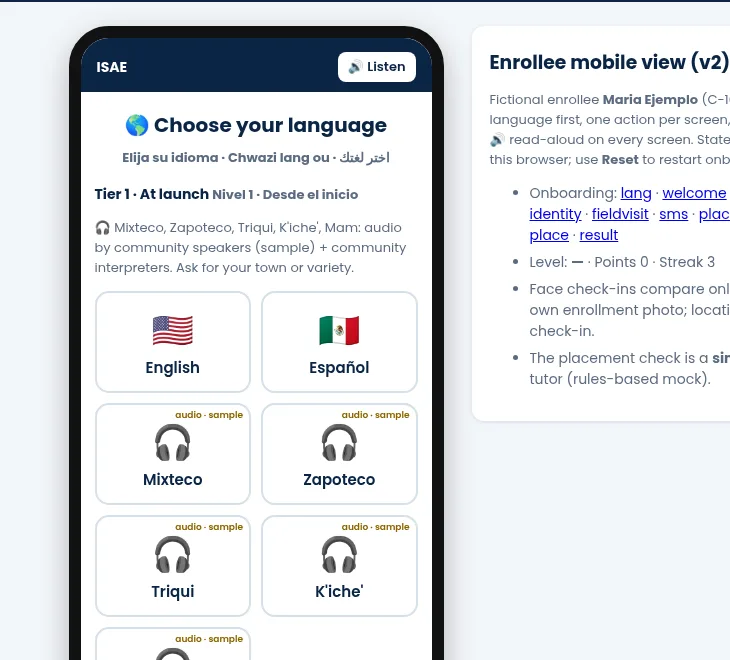
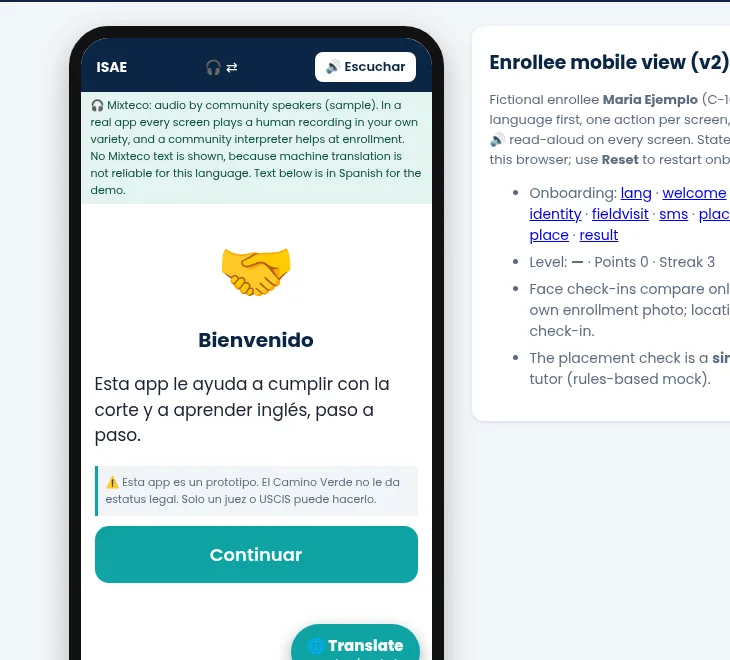
English, Spanish, and the Indigenous languages Mixteco, Zapoteco, Triqui, K’iche’ and Mam. Spanish covers the largest group. The Indigenous languages go in the first tier, not the last, because their speakers live where a pilot is likely to start and are the people a Spanish-only app would fail. They are delivered with human-recorded audio and paid community interpreters. Machine translation for these languages is weak or missing, so the app never shows machine-generated text in them.
Tier 2: next
Haitian Creole, Brazilian Portuguese, Mandarin, Cantonese, Vietnamese, Tagalog. Large, established groups.[71] Full written screens and audio; machine translation in the helper only after testing with community reviewers.
Tier 3: later
Hindi, Punjabi, Gujarati, French, Arabic, Russian, Ukrainian. Groups that have grown recently or are concentrated in a few metros. Written notices and phone interpreters first; full screens when pilot data show the need.
Still to decide: Korean is in MPI’s national top five[71] but not in these tiers, and Q’eqchi’ is a larger first language in Guatemala than K’iche’ or Mam.[74] Both need review against pilot-site data.
How it works in the app
- Language first. It is the first choice at field enrollment and in the app, spoken aloud, and can be changed from any screen.
- Audio first, reading optional. Every screen has a listen button; court dates, check-ins and rights notices can come as a voice call or voice message.
- Interpreter at enrollment. If an interpreter for the person’s variety is not available, the visit is rescheduled. It does not go ahead in Spanish unless the person is comfortable in Spanish.
- The translation helper shows its limits. Each language is labeled “Vetted,” “Testing” or “Interpreter only.” For the Indigenous languages it offers recorded phrase cards and a one-tap human interpreter.
- Checked by the community. Professional translation, then review by at least two paid community reviewers, back-translation for legal content, field testing, and a way to report mistakes.
- Language is never a risk factor. Language data is not used for triage or enforcement.
The hard part: cost and people
This is the slowest and most expensive piece of the enrollee experience, and it does not scale like software. Recordings have to be redone every time the content changes. Interpreters for particular Mixteco, Zapoteco and Triqui varieties are scarce, and community groups already rely on them for health, school and legal help.[72] [73] ISAE has to pay for interpreter time and train new interpreters, not borrow from that thin capacity. We found no verified per-language cost figures, so pilot budgets must be built from local quotes.
The honest risk. If the Indigenous audio is not ready on day one, the pilot will in practice serve Spanish speakers only, and miss the families with the greatest need. The specification therefore says a site should not launch until its Tier 1 audio has been reviewed.
Full requirements (LANG-01 to LANG-14) in the product specification, Section 6.11 →
On this website
The home summary and “How it works” are available in Spanish. The detailed policy pages stay in English because their readers are officials and legislators. Summaries in other Tier 1 and Tier 2 languages, including audio for Indigenous languages, should be produced and reviewed by community translators; none are published yet.